Fit for a queen

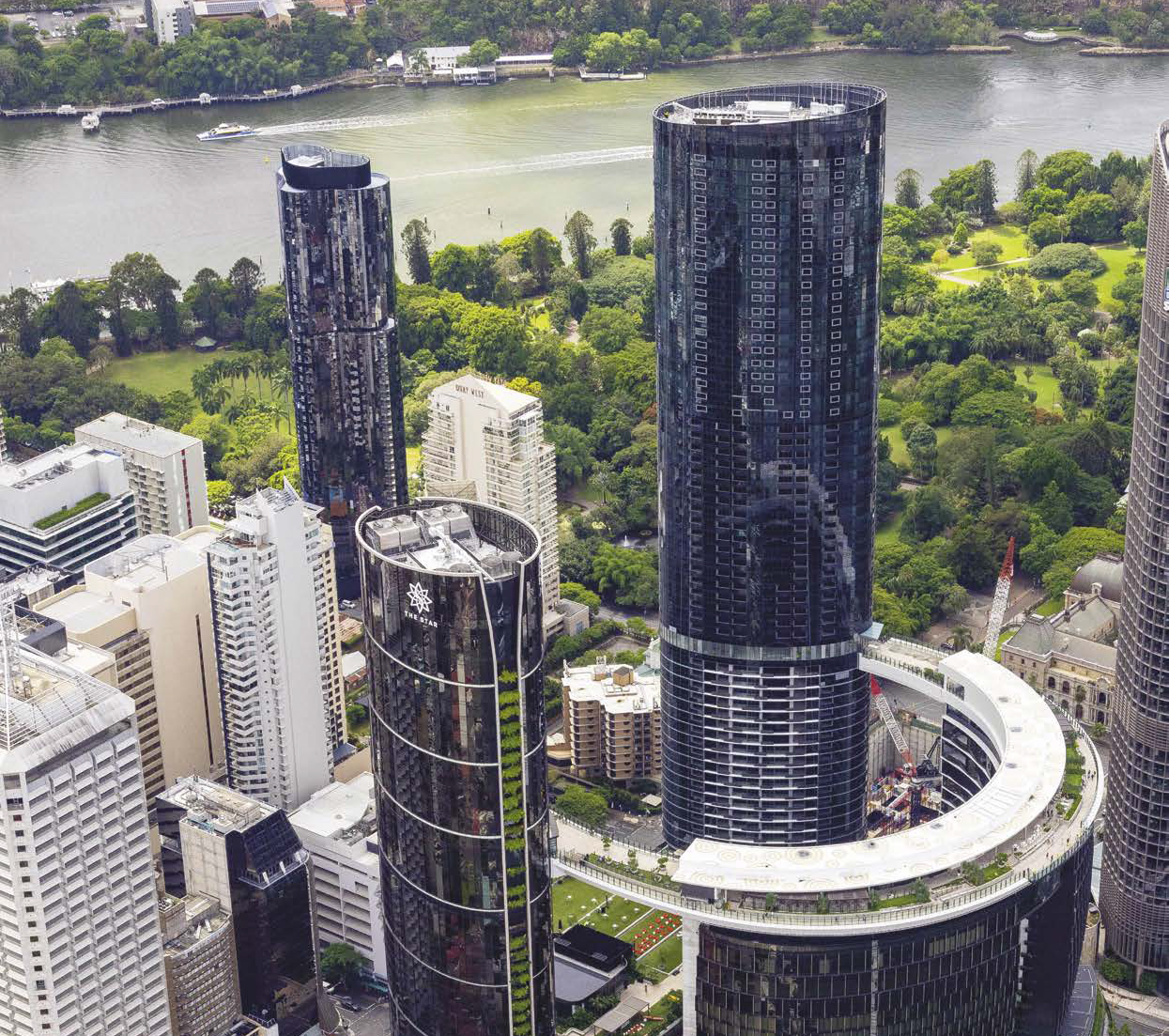
With over 185,000m² of internal floor space, Brisbane’s Queens Wharf resort complex is one of the largest developments of its kind in Australia.
Just a year after it opened to the public, Queens Wharf already cuts one of the most iconic shapes on Brisbane’s skyline. Consisting of three interconnected towers, the semicircular complex wraps around a lush open-air park and event space. From the riverbank, the seamless facade twinkles like a giant mirror. From the city side, it looks like the kind of garden party venue that even the Great Gatsby would be jealous of.
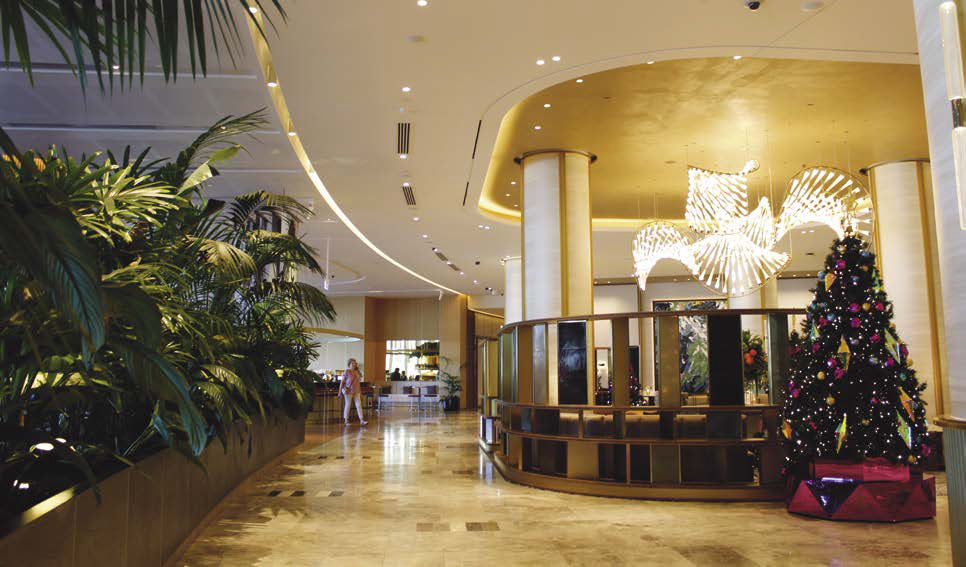
Inside these towers is a world of its own. The multi-use complex includes private apartments, high-end hotels, retail hubs, entertainment facilities, a brand-new casino, and public walkways.
It’s not just sky-high podium bridges and promenades that connect these buildings. At the heart of this city within a city is one of the most extensive HVAC systems in the country.
Winner of the Excellence in HVAC – Best New Project category at the 2025 AIRAH National Awards, this intricate system spans kilometres of duct and pipework, overcoming extreme design challenges to provide comfort, performance and efficiency. Here’s how this megalithic HVAC project unfolded.
Connection perfection
Martin Ling, Affil.AIRAH, is a Senior Project Engineer at Ellis Air. He led the Ellis team responsible for the following components of part A of the project, which began in 2019:
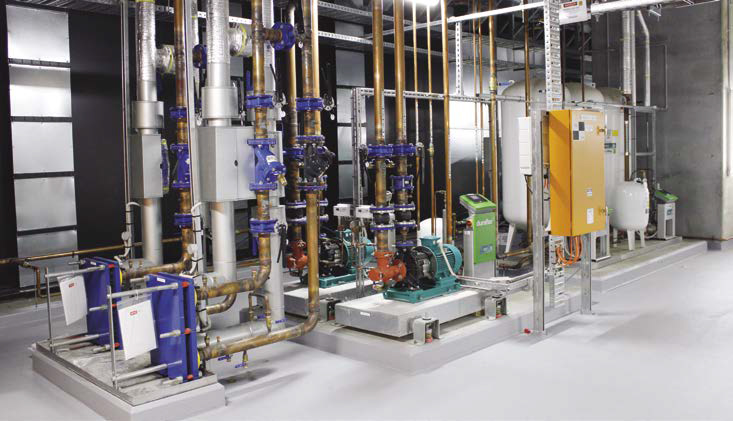
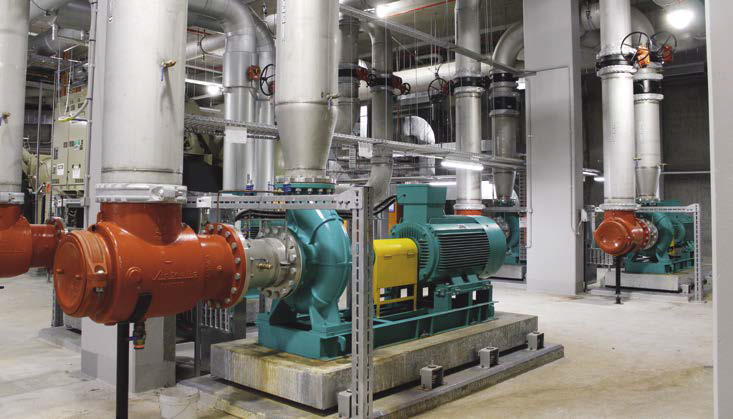
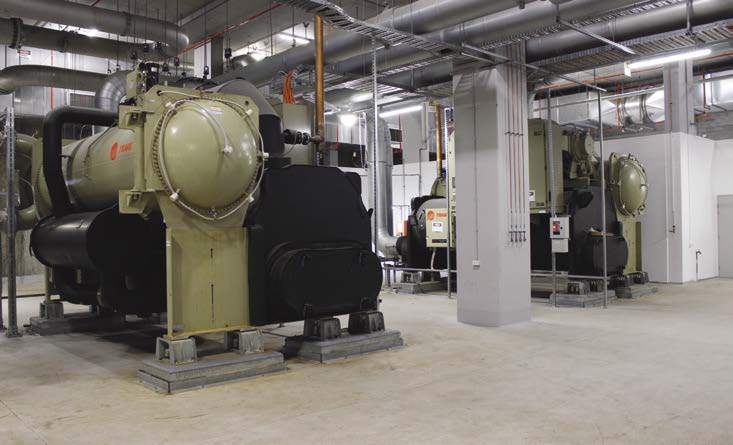
- Central energy plant for the resort consisting of water-cooled centrifugal chillers, chilled water pumps, hot water pumps, condenser water pumps, gas‑fired boilers, cooling towers, food and beverage heat rejection system via a secondary condenser water system and tertiary condenser water system for heating pools
- Mechanical services infrastructure
• Life safety systems to the Skydeck, towers 1, 2 and 3, the podiums and the basement
• Chilled water, heating hot water, secondary condenser water to the Skydeck, towers 1, 2 and 3, the podiums and the basement - Basement mechanical services
- Mechanical services from level 0–1.
From 2020, Ellis Air was also engaged to deliver:
- The remainder of the podium mechanical services from levels 2–7 (mezzanine), including:
• Mechanical services base build to the restaurants on level 4
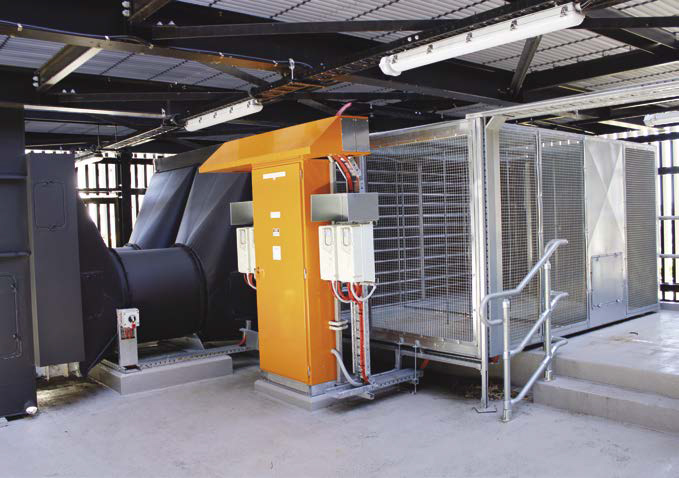
• The casino’s mechanical plant, consisting of air handling units (AHUs), FCUs, and ventilation fans with capped-off ductwork
• The casino’s life safety smoke exhaust fans
• The ballroom on level 6
• The public realm on level 7
• Skydeck lobbies and mechanical base build infrastructure
• Skydeck life safety smoke exhaust fans for hotels and upper gaming - Automatic waste collection system
- Laundry services
- Cold room refrigeration package
- Beer refrigeration package
- Infrastructure (chilled water and heating hot water) and life safety equipment (stair pressurisation fan and smoke exhaust) to all fit-out areas in towers 1, 2, 3 and the Skydeck.
A.G. Coombs also played a major role in the Queens Wharf project. The company was responsible for the complete mechanical systems and central plant in tower 4, the complex’s 65-storey residential development. A.G. Coombs also delivered mechanical systems for towers 2 and 3, as well as for casino spaces including the Skydeck and upper gaming areas.
In total, A.G. Coombs installed more than 12,000 individual pieces of equipment in the complex, including plant and mechanical services. Prefabrication played a significant role in this – the company engineered and designed riser systems for the upper gaming areas in its Melbourne facility, before working with local suppliers for fabrication and assembly.
It was a huge and intricately detailed project, one made all the more challenging by the fact that all these elements needed to connect to each other.
“The HVAC systems and building services are connected across the entire complex,” Ling says.
“The chilled water, heating hot water, condenser water systems are all centralised and reticulate to serve the podiums, Skydeck and towers 1, 2 and 3 of the project.”
Leaving nothing to chance
The casino gaming floors were among the most complex areas for HVAC design. These wide-open spaces presented significant challenges for smoke and fire control and required an alternative fire safety plan, which led to the installation of over 100,000L/s of smoke exhaust systems to the podium gaming floors.
Constant and fluctuating foot traffic means these areas also require tight temperature and humidity control, which is provided by the AHUs. This setup allows for future flexibility if changes or modifications need to be made to the machines located on the gaming floor.
“There are over 15 different AHUs serving the gaming floors at the same time with an ever-changing load profile of gaming machinery and patrons,” Ling says. “Zoning control is especially important on the gaming floors to ensure patrons are kept comfortable at all times.”
Core performance
Bringing all these components together is the central energy plant (CEP), the crown that sits atop the Queens Wharf development. The CEP manages the heating and cooling needs of the entire resort area across the Skydeck, towers 1, 2 and 3, the podiums and the basement.
Schneider Electric’s business leaders and sales teams sought the Queens Wharf project over several years, identifying it as the largest development in Brisbane and the perfect opportunity to implement a cutting-edge control and operations system. Denver Treacy is one of the Project Engineers for Digital Energy at Schneider Electric who worked on the Queen’s Wharf building management system (BMS). From his perspective, the CEP is what sets this project apart.
“From an engineering standpoint, the central energy plant (CEP) was the most innovative element of the Queens Wharf project,” Denver says.
“Utilising central plant to serve such a diverse range of functional spaces is an outstanding achievement.”
Turning this CEP into a reality included several innovative approaches in the design, installation and operation phases:
- Four high-efficiency counter/cross-flow chillers – using R1233zd(E) refrigerant, with ultra-low global warming potential – operating in series to deliver more than 20MW of cooling capacity. These were introduced using a phased commissioning approach, with design parameters accounting for staging plant loads and possible power outages.
- Cooling distributed via a 500mm flow and return bidirectional ring main, a design that ensures redundancy and uninterrupted cooling across all podiums and towers, as well as the Skydeck
- Heat rejection managed by four rooftop cooling towers working in series, each capable of rejecting over 7.5MW of heat. The arrangement and monitoring of these cooling towers exceeds Green Star standards and expectations in terms of staging, water flow and water consumption
- Clever engineering that uses condenser water for multiple functionalities, including harnessing the heat rejected by the cooling towers to heat three onsite swimming pools
- A highly coordinated approach to commissioning combining multiple skillsets, allowing for a coordinated effort for witness testing and high-quality performance for end-users.
And while countless hours of work went into this design, the result has clearly been worth it.
Pooling resources
A mechanical services system like the one at Queens Wharf generates plenty of excess heat. Instead of rejecting that heat into the atmosphere as waste, Ling and his team devised a system to recapture the surplus heat and use it to keep the precinct’s three swimming pools at the ideal temperature.
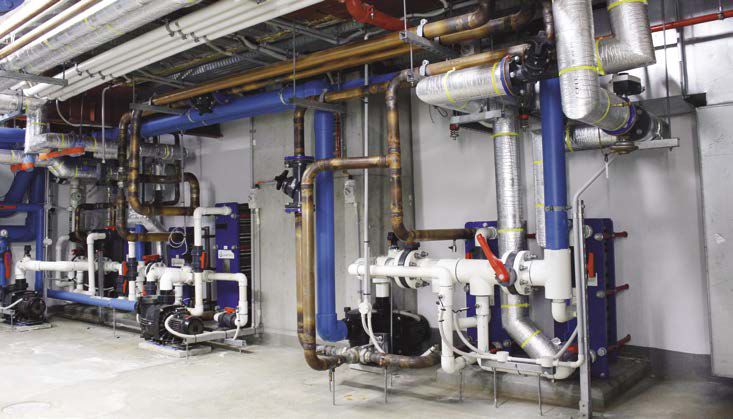
“This system works on the fact that the return condenser water is at 37°C, which is sufficiently high to be utilised to heat up the swimming pools to their required temperatures (28°C),” Ling says. “Rather than rejecting the cooling tower waste heat into the atmosphere, we designed a system using a series of heat exchangers installed within the pool plant room to provide heating to the pools and thereby provide free heating to the precinct.
“There is sufficient heat from the condenser water to heat up all three pools during spring, autumn and summer. However, depending on the return temperature from the condenser water in winter, there may be times when the water isn’t quite warm enough. In this case, heating hot water is provided via a heat exchanger.”
Ling says the team is open to opportunities to use waste heat in other creative ways in the future.
Two-way loop
If the CEP is the crown atop the Queens Wharf mechanical package, then the reversible chilled water ring main might just be the jewel within that crown. Ling identifies this as a breakthrough design approach that allows the system to span multiple buildings and says it could make sense in other projects of similar scale and complexity.
“The reversible chilled water ring main allows for a single central energy plant to provide chilled water to multiple types of buildings, as well as providing redundancy by allowing chilled water to reticulate in both directions,” Ling says.
“The reversible chilled water ring main was one of the ideas that helped Ellis Air win the tender. I would say that would be one of the key things that should be introduced to other similar projects.”
The system was expected to save energy by maximising functionality and flexibility. Monitoring shows that it is outperforming even the modellers’ more ambitious predictions.
“Based on the BMS data that we have received, there appears to be less energy usage in the entire precinct then originally modelled,” Ling says.
“This means the central energy plant is operating at partial load – and thus at its higher efficiency point – which means energy savings for the project.”
Bespoke approach A multi-building development requires components designed to meet the specific needs of each zone within the complex.
Some of the bespoke solutions used the following machinery:
- Constant volume AHUs for general ventilation
- Energy recovery ventilators for improved efficiency
- Run-around coil systems for enhanced heat recovery
- Specialised computer room cooling units for mission-critical data rooms.
Another consideration was the many commercial kitchens located throughout the complex. The designers used specialist kitchen exhaust treatment units from the USA that enable horizontal kitchen exhaust discharge. These systems are equipped with electrostatic precipitators and carbon filters to minimise odour and grease emissions while maintaining compliance.
Total control
Selecting the right physical infrastructure to allow the CEP to function as intended is important. Ensuring that those components all talk to each other is another matter entirely.
The Schneider team was engaged to turn the dream of a fully interconnected system at Queens Wharf into a reality.
“Schneider Electric handled the interface, monitoring, and control of 17 integrated systems,” Denver says.
“Since we were contracted directly by the principal managing contractor, we were able to coordinate with all major trades and, in some cases, multiple contractors within the same discipline.”
He says the CEP – while complex to design and set up – makes monitoring and control simpler than it would be if there were multiple systems.
“With central plant, the effort required for operational control and monitoring is substantially lowered,” he says.
The “brain” of the building – responsible for ensuring that everything operates as it should – is the building management system (BMS). The Queens Wharf BMS is an all-in-one technological and visual platform.
“The BMS has a service layer for day‑to‑day work and a higher-level view that lets operators oversee every discipline from one place,” he says.
“The graphic dashboards provide users with a comprehensive view of plant status and performance, while flagging any zones requiring attention. This capability is delivered through functional alarming and continuous event monitoring.”
Events within the system can be instances of poorer than expected performance that warrant inspection, but are not necessarily critical. And while system alarming is more serious, it isn’t necessarily as … alarming as it sounds.
“Say an AHU fan has gone into fault,” Denver says. “In that situation, an alarm will be raised. The alarm can then be managed by facility staff throughout the rectification of the fault and beyond. Staff can easily track the history of the alarm as well as add notes to a particular alarm for future reference.”
Maintenance matters
One of the advantages of the BMS at Queens Wharf is its use of building analytics to simplify maintenance and repair.
“By capturing extensive and detailed information, the BMS allows problems to be detected early and provides users the ability to analyse them instantly,” Denver says.
“The BMS proactively highlights performance anomalies, allowing early intervention to prevent energy wastage and maintain occupant comfort while creating a record that can be monitored and followed up.”
It’s not just facility managers who use the BMS; the system has also been designed with maintenance professionals in mind.
“At Queens Wharf, the BMS is built for performance and simplicity,” he adds. “Service teams can quickly pinpoint issues, add notes, and safely lock out equipment, while facility managers get a comprehensive overview, all through one integrated platform. Every action is tracked electronically, ensuring nothing is missed and operations run smoothly.”
Race against the clock
For all the preparation in the world, there are critical junctures in any major project where everything simply has to go right. At Queens Wharf, one of these moments was the changeover of the cooling towers.
“Due to the construction program and the need for earlier cooling for the lower podiums, we had to install half the cooling towers (over 15,000kW of heat rejection plant) in a temporary arrangement on level 3 instead of their home on top of tower 1,” Ling says.
“A total redesign of the condenser water system had to occur halfway through the installation to allow for the cooling towers to be located onto level 3. This included CFD plume studies to ensure that neighbouring buildings were not affected by the locations of the temporary cooling towers.
“That was the easy part. What came next was far more challenging: relocating the cooling towers to their forever home atop tower 1 after its completion, all while keeping the whole precinct operational.”
The team did this by installing the remainder of the cooling towers and all the relevant ancillary components at the top of tower 1. They then had a four-hour window to complete the changeover process.
“Four hours was the maximum allowable time that the precinct could remain without heat rejection,” Ling says. “This process had to occur in the middle of the night.”
During that four-hour window, the following had to occur:
- Closing and opening numerous valves throughout the condenser water system
- Filling the condenser pipework with water
- Stopping and restarting the condenser water pumps
- Stopping and restarting the chillers
- De-energising the cooling towers on level 3 and energising the new cooling towers atop tower 1.
“Thankfully, due to the planning and work of the commissioning team – as well as the chilled water ring main acting as a thermal storage of 5°C chilled water during the period – this entire changeover process was successful and the precinct was not affected,” Ling says.
Millimetre perfect Another do-or-die moment was the installation of the four massive chillers, which came with the kind of complication that could only happen during the COVID-19 pandemic.
“The chiller plantroom was located on L0 in the cavernous underground section of the building that housed the central energy plant,” Ling says.
“The chillers were manufactured in Wuhan, China, right at the height of COVID, which meant that they would not arrive at the Port of Brisbane before the L1 and L2 slabs were poured.”
This meant including holes in the slabs on levels 1 and 2 that were big enough to fit the chillers through, but not so big as to create problems with water egress.
“The final hole provided around 200mm clearance all around, which turned out to be sufficient for the chiller lift,” Ling says. “In the end, during one Sunday operation, four 30 tonne chillers were successfully lifted and skated into place. After being lowered, the chillers were to be skated into position using heavy-duty skates, with a forklift chained to the chiller to provide the necessary moving inertia.”
Creating a landmark It’s rare that a construction project makes an instant impact on a city. Queens Wharf is an exception. With thousands of daily visitors – both locals and tourists from abroad – already enjoying the remarkable precinct, it’s clear that this development will shape Brisbane for decades to come. And making it all possible is a truly remarkable HVAC system that few will ever realise is there.
Project at a glance
PERSONNEL
Mechanical design and construction:
Ellis Air Conditioning Qld (Ben Higgins,
Iain Fraser, Matthew Chudasko, Matthew
Raynham, Graeme Carbery, Martin Ling,
Lee Watson and Warwick Williams)
Mechanical services installation:
A.G. Coombs
Builder: Multiplex
Architect: Cottee Parker
Structural engineer:
Bornhorst and Ward, WSP
Certifiers: McKenzie Group
ESD/Greenstar: EMF Griffiths
Fire engineering: WSP
Acoustic engineering: Acoustic Logic
Mechanical design peer-reviewer:
EMF Griffiths and WSP
Client:
Destination Brisbane Consortium (DBC)
EQUIPMENT
Attenuators: Austmet Fabrications
Air handling units: Daikin
AC units: Sinko
Boilers: Simons Boilers
Blast chiller evaporators:
Williams Refrigeration
Beer and refrigerant condensers: Bitzer
Beer and refrigerant heat exchangers:
Alfa Laval
Centrifugal close-coupled pumps:
Grundfos
Chillers: Trane
Cooling towers: Evapco
Computer room air conditioning:
UAP Solutions
Condensate pumps: Aspen Pumps
Dirt separators: Automatic Heating
Dosing pots: Automatic Heating
DX packaged units: Daikin
ERV air handling units: Armcor
Electric duct heaters:
Advanced Access & Digital Controls
Expansion tanks: Automatic Heating
Electric boiler: Rheem
Fans: Fantech
Fan coil units: Daikin
Filters: Airpure
Heat exchangers: Sondex
Ice machines: Follet Ice
Kitchen exhaust hoods: Stoddart
Kitchen exhaust treatment units: Airpure
Pumps: Wilo
Run-around coil pumps: Grundfos
Refrigerant evaporators: Bitzer
Spray booth systems: BlastOne
Mechanical services switch boards:
Versatech, EMES
VAVs: Celmec
VSD: ABB
Vacuum degassers: Automatic Heating
Workshop equipment: Ozone
Motorised VCD: Bullock
Motorised smoke dampers: Celmec
Fire dampers: Bullock
Motorised fire smoke dampers: Bullock
From our advertisers

Recent articles



Latest edition
See everything from the latest edition of Ecolibrium, AIRAH’s official journal.