Quiet confidence


We review the debut book by Australian HVAC engineer and writer Gary (Guru) Raman, Affil.AIRAH
Gary Raman is a senior engineer with more than 15 years of experience in the HVAC industry, specialising in the refurbishment, defence, education and commercial sectors.
He’s also an accomplished writer; if you’ve read recent issues of Ecolibrium or HVAC&R News, you will have come across one of his feature articles on refurbishment engineering or the parallels between HVAC and the human body. But success hasn’t always come easily to Raman. When he began his career, he often struggled to have his voice heard in a world that seemed to favour the outspoken and classically charismatic. In his new book, Subtle Powers for Super Leaders: A Practical Guide for Introverts to Rise, Influence & Lead, Raman shares how he transformed these challenges into his greatest strengths, offering a practical framework for introverted professionals to lead with confidence and quiet authority.
Here’s what you can expect from Raman’s first full-length book.
“It’s time to step up, not by changing who you are, but by owning your innate strengths and mastering the subtle powers that make you an extraordinary leader.”
Gary (Guru) Raman, Affil.AIRAH
The changing face of leadership
As workplaces evolve with remote, hybrid, and AI-driven environments, the concept of leadership is shifting. As Raman suggests, leadership no longer necessarily requires dominance, assertiveness, visibility, or charisma. Instead, the “brave new world” of the corporate workplace increasingly values introverted leaders for their observation skills, strategic and thoughtful influence, and collaboration rather than competition.
Raman’s book speaks directly to introverts who often feel overlooked or depreciated in the workplace. It aims to empower them by showing that their innate “powers” – such as deep listening, empathy, careful preparation, and strategic thinking – can be leveraged to achieve long-lasting success and career growth.
“It’s time to stop sitting in the background. It’s time to step up, not by changing who you are, but by owning your innate strengths and mastering the subtle powers that make you an extraordinary leader,” Raman writes in the introduction, delivering a motivational punch to readers.
He takes a pragmatic approach by introducing a four-phase, 25-power framework designed to help introverts develop their innate leadership abilities. The framework he devises blends neuroscience, psychology, real workplace, politics, sports and popular culture case studies, while proposing actionable routines to deliver results.
Raman writes in an engaging and accessible style, using bullet points, illustrative tables and flowcharts, and vivid examples to clearly demonstrate the strategies he proposes. The central message of the book is about revalorising introverts’ strengths and authenticity. Rather than urging readers to mimic extroverted styles, Raman shows leadership-inclined introverts how to lead effectively without losing their natural edge.
Building the foundation
The book begins by helping readers understand their introverted type (classified into thinking, social, anxious, and restrained introverts) and how to personalise their leadership journey most effectively. The initial chapter, or phase 1, is all about building the “core foundation” by developing self-mastery (self-awareness, emotional intelligence and self-discipline), power of visualisation, strategic thinking, productive focus, perceptive observation, and adaptability. According to Raman, these foundational skills are essential, as they provide the lens through which introverts can analyse situations, respond intentionally, and approach challenges strategically.
Strengthening influence and presence
Once the internal foundation is set, the book shows how emanating subtle authority and inviting respect and collaboration can be more influential than asserting dominance or being controlling. Here, Raman explores the empirical value of the notion of “commtelligence”, which he defines as the intelligent use of communication to connect, interpret, and influence. As introverts often excel at thoughtful, purposeful communication, this section shows how to use that skill to build trust and foster collaboration in professional environments.
Raman also covers executive presence, relationship intelligence, conflict navigation, preparation, and collaboration over competition. These chapters illustrate how introverts can exert quiet authority through emotional intelligence, strategic observation, and deliberate action. Small, intentional behaviours – like choosing words with care or understanding unspoken workplace dynamics – can yield influence.
A case study of Christine Lagarde, President of the European Central Bank (ECB) and formerly the first female Managing Director of the International Monetary Fund (IMF), illustrates how perceptive observation and strategic patience can allow introverted leaders to “break the glass ceiling” and thrive at the highest levels.
Leadership and career ascendancy
In the third phase, Raman addresses decision‑making, political intelligence, leadership thinking, strategic credibility, and influence without authority. These chapters show how introverts can leverage subtle powers to navigate complex workplace politics ethically, establish trustworthiness, and make impactful decisions.
Raman interestingly reframes the concept of politics as the “ethical navigation of human systems”, highlighting the advantage introverts have in reading between the lines and understanding unspoken power dynamics. Chapters on signature strengths, recognition, and political intelligence emphasise that leadership is not about dominating the room but about becoming the catalyst for others’ success.
“Influence does not belong solely to the loud; it belongs to the clear, the committed, and the generous. Mastering one art, teaching it well, and using it to uplift others carves out a path to visibility and meaning,” Raman notes, highlighting the value of developing a signature strength.
Sustaining and expanding influence
The final phase addresses sustainability: ensuring that one’s leadership impact endures. Here, Raman explores renewal, strategic association, differentiation, change influence, self-investment, and building a legacy.
He advocates for an ethical leadership style rooted in integrity and authenticity, encouraging introverts to value their qualities and contributions that differentiate them from others. He invites them to continuously invest in themselves while strategically positioning their influence in the work sphere, ensuring that their leadership is both empowering and long-lasting.
“For introverts, the power of differentiation offers a way to gain visibility without compromising integrity, earn respect without loud self-promotion, and build influence by aligning with their deepest strengths”, Raman writes.
Why this book matters
Unlike many leadership guides, Subtle Powers for Super Leaders is specifically tailored for introverts. Practical exercises, routines, and analytical reflections throughout the book make many of Raman’s complex concepts accessible and actionable. From using power poses to enhance confidence, to focusing on clear, empathic communication, Raman’s guide provides a practical, evidence-based roadmap to thrive in the workplace.
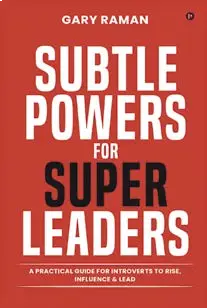
Get your copy
Subtle Powers for Super Leaders by Gary Raman was published in December 2025. The book is available for purchase on Amazon via the QR code.

“Influence does not belong solely to the loud; it belongs to the clear, the committed, and the generous.”
Gary (Guru) Raman, Affil.AIRAH
About the author
Dr Mara Antic is a freelance writer and teaching associate at the School of Media, Film and Journalism at Monash University. Her research interests include feminist theory and women’s filmmaking with an emphasis on representations of gender, sexuality, and cross-cultural identity. Her work has appeared in The European Journal of Life Writing, Feminist Media Studies and MAI: Feminism and Visual Culture. Her first book, Cinematic Homelands, was published by Palgrave Macmillan in 2024.
This article appears in Ecolibrium’s Autumn 2026 edition
View the archive of previous editions
From our advertisers


Recent articles



Latest edition
See everything from the latest edition of Ecolibrium, AIRAH’s official journal.