Choosing the right air filter for AS 1668.2:2024


Simple, or not so simple?
Australian air filtration requirements for mechanically ventilated spaces are about to undergo a seismic shift – bringing local standards in line with international peers after lagging behind for over a decade.
The key change is the introduction of a new air filter performance rating standard AS/ISO 16890, referenced in AS 1668.2:2024 including for reduction of outdoor air ventilation rates.
AS 1668.2:2024 is referenced by the National Construction Code (NCC) from May 1, 2026 in Victoria and from May 1, 2027 in New South Wales and Queensland, subject to final jurisdictional adoption.
This means that …
AS 1668.2 specifies the minimum outdoor airflow requirements for indoor spaces (Table A1). For many commercial buildings, the most common compliance pathway has historically been:
- A baseline 10L/s*person (litres per second per person) outdoor air, and
- a reduction in outdoor air using recirculation and filtration.
That pathway still exists. What has changed is the classification of filtration required to use it.
Put simply: the AS 1324 rated air filters that were considered acceptable under the previous version of AS 1668.2 did not pose an effective barrier for the most harmful airborne particles1. The new standard moves to correct this.
New to AS 1668.2:2024 is the Simple Procedure which is expected to be the dominant method used by designers.
This article will cover:
- What changed
- How can designers comply simply
- Can higher filtration performance can be delivered without increased pressure loss, energy use and operating costs?
For this discussion the Detailed Procedure, alternative calculation pathways, and niche use cases such as Borrowed Air are intentionally left out. Although AS 1668.2:2024 does reference ASHRAE 52.2 Appendix J (MERV-A) there is not a clear cross walk to the AS/ISO 16890 filter rating system. Refer to the Detailed Procedure in Table D1.
In brief
The most common design pathway has moved from filters that captured as little as 1% of the most harmful particles to filters that routinely capture 40% in a single pass, delivering a 40X indoor air quality improvement for building occupants.
AS/ISO 1668.2:2024 deliberately raises the effective minimum filtration performance rating for the most common design pathway to provide:
- Improved indoor air quality across the building stock
- More consistent real-world filter performance
- Greater clarity in filter performance rating selection.
For designers, the simple procedure reduces complexity.
For owners and operators, the focus shifts from filter class labels to delivered outcomes.
For occupants, the air is cleaner and so expected to be healthier and safer.
Greater filtration efficiency typically results in a pressure drop penalty, leading to increased energy and operational costs. Life-cycle cost analysis using Camfil’s LCC V3.0 and backed up by real world measured data shows that modern filtration solutions can provide users with cost and energy efficient standard compliant alternatives to legacy products.
Rationale for change: improved indoor air quality
Air pollution is a major environmental risk to health. The World Health Organization has reported that a large proportion of the global population is exposed to air that exceeds guideline levels, with substantial associated mortality (WHO, 2019).
Epidemiological and mechanistic studies continue to expand the range of health outcomes linked to particulate matter exposure, including neurological and cardiopulmonary endpoints (Dominici, 2024).
In parallel, evidence has accumulated that many respiratory pathogens can be transmitted via aerosols (Wang, 2021), highlighting the importance of controlling airborne particles in occupied indoor environments.
Because most individuals in nations including Australia spend a large proportion of their time indoors, long-term exposure to indoor pollutants can contribute substantially to overall dose (Allan, 2024). Accordingly, ventilation design, source control, and filtration are key engineering controls for indoor air quality (IAQ).
Engineering approaches to improve IAQ – including effective air filtration and evidence-based ventilation strategies – are widely available and increasingly codified (Allan, 2024).
AS 1324.1 vs ISO 16890-1
Previously under the old standard, AS 1324, an “F5”2-rated filter was deemed a suitable basis to reduce outdoor air ventilation rates. In the update of AS 1668.2:2024, the Simple Procedure requires filter ratings to be reported using AS/ISO 16890.
A key technical distinction from old to new is the treatment of media electrostatic charge effects.
The ISO 16890-derived AS 16890 incorporates procedures intended to better represent real life average performance of air filters and after any filter media electrostatic charge has been neutralised or reduced, whereas AS 1324 does not.
Accordingly, AS/ISO 16890 can better provide a more directly comparable basis for particulate filtration performance across manufacturers than AS 1324.
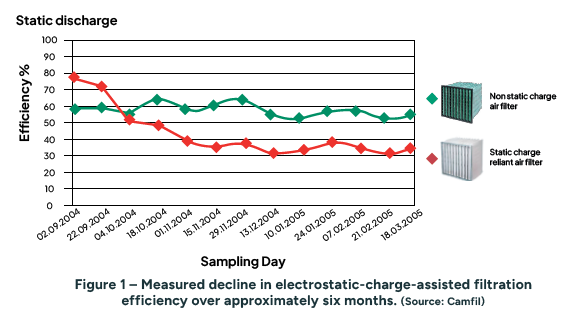
An electrostatic-charge-assisted filter shows high initial efficiency that decreases as the charge dissipates, often to lower than the average performance sought. Whereas a mechanically efficient (non-electrostatic-dependent) filter can exhibit a more stable performance as it loads with particulates. (Raynor, 2004)
Crucially, AS/ISO 16890 accounts for loss of any media performance enhancing static charge, whereas AS 1324 does not. This avoids a filter carrying a performance rating classification that may not be achieved in real-world conditions.
The example in Figure 1 reports on two filter efficiencies measured over approximately six months. The electrostatic-charge-assisted filter shows a high initial efficiency followed by a significant decline to a low average efficiency, whereas the comparison filter exhibits comparatively consistent performance. Such behaviour is the rationale for test protocols that account for electrostatic discharge when reporting efficiency classifications.
The question every designer is now asking – how to comply?
The Simple Procedure states (Clause 2.8.2):
“Where the enclosure ventilation is occupancy based (only where qf [the minimum effective outdoor airflow rate required per person or per unit of floor area] is listed in Appendix A as L/s/person), the minimum introduced outdoor airflow rate as calculated in Clause 2.8.2.1 or Clause 2.8.2.2 may be reduced by 25% for each enclosure where —
- At least 50% of the supply air is recirculated; and
- All recirculated air passes through a particulate filter with minimum efficiency of ISO ePM2.5 > 50%.” (Standards Australia, 2024)”M
For the Simple Procedure, compliance is straightforward.
If you intend to reduce outdoor air ventilation by 25%:
- Specify filters rated to ISO 16890 ePM2.5 ≥ 50%, and
- Require documentation that demonstrates this performance to the standard.
AS 1324 derived classifications must not be used as a proxy for compliance.
If outdoor air is not being reduced, AS 1668.2:2024 still permits the use of coarse filtration, typically ≤ ISO ePM10 50%, broadly equivalent to AS 1324 G4 filters.
The Simple Procedure opens a straightforward pathway for designers to reduce outdoor air by 25%. As a result, it could be expected that ISO ePM2.5 ≥ 50% filtration will apply to many projects.
For projects governed by the NCC adoption of AS 1668.2:2024, practitioners must expect procurement, commissioning, and compliance documentation to shift from AS 1324 class labels to ISO 16890 fractional efficiency classifications for air filters.
In practice, this affects:
- How filters are specified in specifications and equipment schedules
- What evidence is accepted during design review and handover.
Outdoor air reduction provisions (Clause 2.8)
Most designers seek to reduce introduced outdoor air to lower heating and cooling loads, provided indoor contaminant control objectives remain satisfied. Halloran (2024) compared increased outdoor air flow, in-room air cleaners, and increased filtration as compliance pathways under ASHRAE Standard 241 and reported that increased filtration can be cost-effective when systems can accommodate appropriately rated air filters. For many existing air handling units (AHUs), filter options may be available that can increase particle-removal efficiency while maintaining acceptable pressure drop, although this must be validated on a system-by-system basis.
AS 1668.2:2024 offers three methods to reduce outdoor air: the Simple Procedure, as discussed in this article, and the Detailed Procedure and Borrowed Air.
Operationally, the Simple Procedure provides a prescriptive pathway: specifying recirculated-air filtration of at least ISO 16890-1 ePM2.5 ≥ 50% permits a 25% reduction in introduced outdoor air for eligible occupancies.
Previous versions of AS 1668.2 required designers to follow the Detailed Method, landing on AS 1324 “F5” or “F6” filters to achieve the same result – a 25% reduction in outdoor air.
AS 1668.2:2024 explicitly cautions against attempting a direct conversion between AS 1324 classes and ISO/ASHRAE ratings. Tables 2.2 and D.1 state (Note 2): “The AS 1324.1 classes are not equivalent classifications to ISO and ASHRAE ratings, however they are included to align with the previous edition of this document.” (Standards Australia, 2024).
To better understand the impact of the changes from AS 1324 to AS/ISO 16890 in AS 1668.2:2024 on filter selection, the comparison table below includes today’s commonly used filters for purposes of outdoor air reduction.
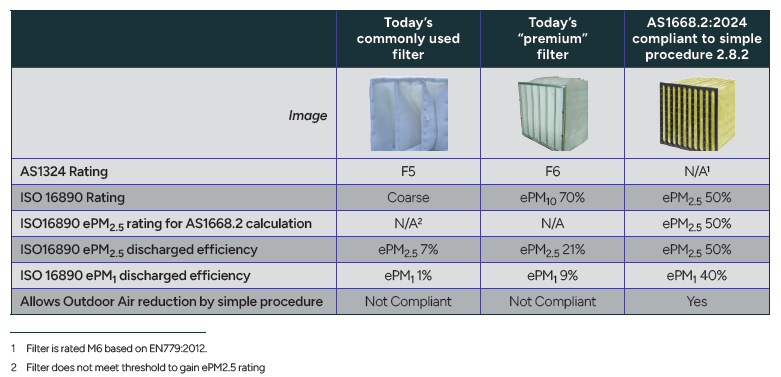
This example shows that filters have significantly different efficiency ratings under AS 1324 and under the more modern and real-world ratings of ISO 16890.
Of note is the enormous forty-fold increase in capture of ePM1 particles from today’s commonly used “F5” filters to the new baseline ePM2.5 50% rated filters.
This presents a huge improvement for building occupants’ health and safety.
Cost and energy implications of the change
HVAC is a significant energy consumer in commercial buildings, and within HVAC, the air circulation fans can represent a major portion of this energy demand. This can raise the concern that increased filtration efficiency requirements come with a proportional energy cost penalty, however it does not have to be the case.
Air filters are only a portion of the overall system pressure drop. However, energy costs can constitute the largest fraction of filtration-related total cost of ownership, often exceeding the filter procurement costs over their service life.
Life-cycle cost analyses demonstrate that higher-efficiency filtration can often be achieved without a proportional energy penalty.
Because AS/ISO 16890-1 provides a harmonised basis for reporting particulate filtration efficiency, it also enables robust energy-comparison frameworks that use ISO 16890-1 test data, including the Eurovent certification and labelling scheme for general ventilation filters.
Eurovent filter energy rating
AS/ISO 16890 classifies air filters based on particulate matter size (PM1, PM2.5, PM10) to improve indoor air quality and efficiency. Filters are rated by their ability to capture at least 50% of specific particle fractions.
Eurovent Recommendation 4/23 provides guidance for selecting ISO 16890-rated filter classes for general ventilation applications and has been iterated since its initial release. (Eurovent, 2022)
In parallel, Eurovent’s energy labelling reports an estimated annual energy consumption derived from standardised pressure-drop measurements as filters load with test dust. (Eurovent 2024)
Eurovent calculations use ISO 16890-1 test-dust pressure-drop measurements (per Eurovent rating methodology) and typically report performance at a nominal airflow of 0.944m³ per second (3,400m³ per hour). Energy ratings are expressed as kWh per year.
Interpreting Eurovent labels
For filters certified under the Eurovent scheme, packaging and/or documentation may include a standardised label that reports:
- Manufacturer and model
- AS/ISO 16890-1 efficiency designation
- Estimated annual energy consumption, and (iv) energy class.
Where available, these labels can be used to screen candidate filters for lower energy impact while maintaining required efficiency.
Comparison between ePM2.5 50% pocket filters
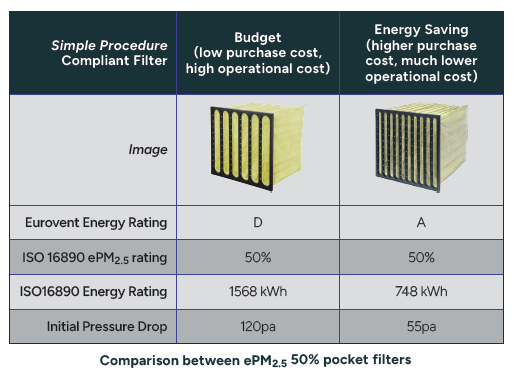
Eurovent provides a standardised basis for comparing filters under defined conditions. For project-specific decisions, additional parameters typically may require consideration, including prefiltration configuration, maintenance interval, labour and disposal costs, electricity tariff, operating hours, airflow setpoints, and control strategy. Sustainability-related metrics (e.g., greenhouse-gas emissions intensity and disposal pathways) may also be relevant inputs to a comprehensive Lifecycle cost assessment.
Better filters can be cheaper
A life-cycle cost analysis assessing total filtration ownership costs includes:
- Filter Cost
- Energy Cost
- Filter Optimal Lifespan
- Labour Cost
- Waste Cost.
You might be wondering if a filter compliant to the new AS1668.2:2024 standard costs less to own than the old F5 rated filter to AS 1324. The following analysis shows that compliant filtration can be implemented with lower total cost of ownership if correctly selected.
Site Details:
- 300 full-size (600 × 600 mm) filters
- Face velocity 1.5 m/s
- Return air proportion 70%
- Fan (wire to air) efficiency 60%.
- 6,552 operating hours per year
- Energy cost at $0.25kW/h
Baseline filter configuration:
- Legacy 50mm prefilter (AS 1324 G4) replaced 6-monthly
- AS1668.2:2024 compliant generic bag filter replaced annually
- AS1668.2:2024 compliant low-energy bag filter replaced at 18 months
For assumptions of filter, electricity, labour and disposal costs, this example indicates how energy and maintenance costs can dominate total cost of ownership for different filtration choices.
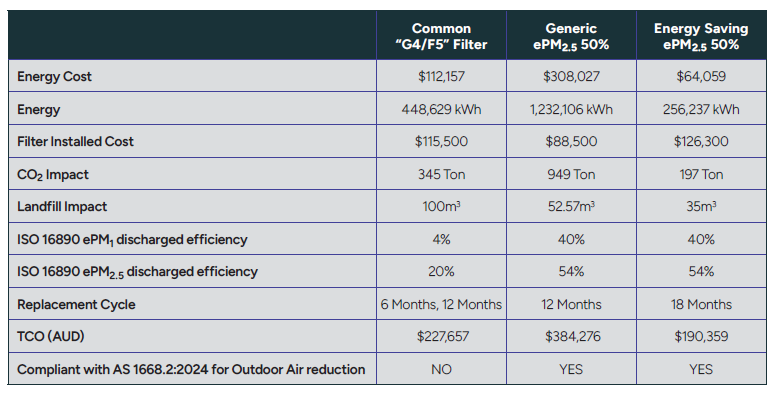
The analysis shows that once the Total Cost of Ownership (TCO) is evaluated, the energy saving filter solution is the most cost-effective, better than the current commonly used F5 filtration solution despite delivering 1000% better filtration performance at ePM1 and 250% better performance at ePM2.5. It also has the lowest carbon emissions.
The results emphasise that higher particulate filtration performance can achieve a lower total cost of ownership and effectively manage system pressure loss and associated energy use.
Equipment selection schedules will need to pair an AS/ISO 16890 aligned specification with energy-aware selection (e.g., Eurovent labels) and potentially project-specific life-cycle cost assessment. Or, just target the lowest pressure loss for the required filter performance rating – noting lower face velocities can assist, as can extended surface area of the filter media (and depth).
Align filter selection with building rating systems where applicable.
Although AS 1668.2:2024 specifies minimum filtration requirements for ventilation design, it does not generally mandate direct measurement of IAQ outcomes in operation (Morawska, 2024). Performance-based rating systems nevertheless incorporate IAQ and energy metrics and can create additional incentives to improve filtration above minimum compliance.
The NABERS Indoor Environment framework includes IAQ as a core component and is recognised by multiple national and international reporting schemes (NABERS, 2022). In such contexts, AS/ISO 16890-1 efficiency reporting, together with energy-comparison tools (e.g., Eurovent labels) and life-cycle cost modelling, can support selections that balance IAQ targets and operational energy use.
Where to from here?
AS 1668.2:2024 updates Australian filtration practice to AS/ISO 16890 rating methods and significantly improves the IAQ outcomes for building occupants.
For practitioners, the revision has immediate implications for the correct specification of air filtration and preparation of design documentation: The AS 1668.2 2024 Simple Procedure compliance pathway for outdoor air ventilation reduction must be based on AS/ISO 16890 performance-rated air filtration. This provides a prescriptive route to a 25% reduction in outdoor air ventilation for eligible occupancies when at least 50% of supply air is recirculated and recirculated air passes through a filter with an AS/ISO 16890 performance ration of ePM2.5 ≥ 50% or greater.
AS/ISO 16890 brings to the Australian HVAC industry a greatly improved filtration performance classification methodology. AS/ISO 16890 is internationally recognised and facilitates simpler comparisons of available products offered in the market in pursuit of AS1668.2 or other building performance rating schemes, as well as in the delivery of improved indoor air quality outcomes.
AS/ISO 16890 also provides the Australian HVAC industry access to the comprehensive Eurovent Energy Efficiency rating tool which allows practitioners to compare filters’ energy use on a level playing field, giving users the ability to select filters that bridge the gap between filtration efficiency requirements and energy efficiency goals.
References
- Allan, J. 2024. How air pollution impacts our brains 31:44. Retrieved from YouTube: https://www.youtube.com/watch?v=PUZw-jg5SiE
- Chen, G, et. al. 2017 Effects of ambient PM1 air pollution on daily emergency hospital visits in China: an epidemiological study, The Lancet Planetary Health, Volume 1, Issue 6, 2017, Pages e221-e229.
- Dominici, F. 2024. How air pollution impacts our brains 01:18. Retrieved from YouTube: https://www.youtube.com/watch?v=PUZw-jg5SiE
- Eurovent. 2022. Selection of EN ISO 16890 rated filter classes for general ventilation applications Fourth Edition. Retrieved from Eurovent.eu: https://www.eurovent.eu/wp-content/uploads/eurovent-rec-4-23-selection-of-en-iso-16890-rated-air-filter-classes-fourth-edition-2022-en-web_0.pdf
- Eurovent. 2024. Energy Efficiency Label | Eurovent Certita Certification. Retrieved from Eurovent Certification: https://www.eurovent-certification.com/en/third-party-certification/energy-efficiency-labels
- Halloran, M. P. 2024. Cost-Effectiveness Of Various ASHRAE Standard 241-2023 Compliance Methods. ASHRAE JOURNAL, 16-20.
- Morawska, L. 2024. Mandating indoor air quality for public buildings. Science, 383, 1418-1420. doi:DOI:10.1126/science.adl0677
- NABERS. 2022. Fact Sheet – Indoor Environment. Retrieved from nabers.gov.au: https://www.nabers.gov.au/sites/default/files/2022-11/Fact%20Sheet%20-%20Indoor%20Environment.pdf
- Raynor, P., & Chae, S. 2004. The Long-Term Performance of Electrically Charged Filters in a. Journal of Occupational and Environmental Hygiene(1 (7)), 463- 471.
- Standards Australia. 2024. AS 1668.2:2024. The use of ventilation and airconditioning in buildings, Part 2: Mechanical ventilation in buildings. Standards Australia.
- WHO. 2019. Ten threats to global health in 2019. Retrieved from Ten threats to global health in 2019: https://www.who.int/news-room/spotlight/ten-threats-to-global-health-in-2019
This article appears in Ecolibrium’s Winter 2026 edition
View the archive of previous editions
From our advertisers
Recent articles



Latest edition
See everything from the latest edition of Ecolibrium, AIRAH’s official journal.