Rethinking humidity in data centres: From electrostatic risk to corrosion control


Recommended relative humidity limits in data centers with a specific focus on the upper and lower limits of relative humidity (RH) – insights from ASHRAE Thermal Guidelines for Data Processing Environments1, Chapter 2.
The objectives of the ASHRAE Thermal Guidelines are to ensure an appropriate indoor environment quality for data equipment and operations.
This includes:
- Providing standardised operating environments for equipment
- Provide and defining a common environmental interface for the equipment and its surroundings
- Providing guidance on how to evaluate and test the operational health of the data centre
- Providing a methodology for reporting the environmental characteristics of computer systems
- Guiding data centre owners and operators in making changes in the data centre environment
- Providing a basis for measuring the effect of any changes intended to save energy in the data centre.
The occupants of a data centre, for the purposes of the guidelines, are the information technology equipment hardware and software. The data centre must be maintained with acceptable environmental limits to guarantee performance, reliability, and energy efficiency.
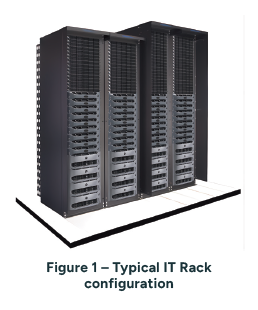
IT equipment environmental measurements
The four key environmental parameters to be considered are:
- Inlet Air temperature
- Inlet Humidity
- Inlet Particulate Contamination
- Inlet Gaseous Contamination.
Outlet temperature is also important and is limited by safety concerns for other equipment and operating personnel, energy efficiency and temperature rise across the servers, which may have implications for server performance and reliability.
Most air-cooled co-location facilities operate based on a 12 Kelvin (k) design temperature rise across the equipment racks, although this may rise to 15-20k for high density and high-performance computing (HPC) applications, although higher airflow temperature deltas are generally accompanied by lower inlet temperatures.
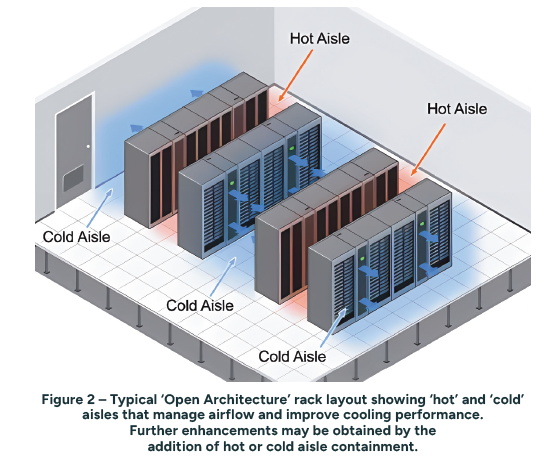
Environmental class definitions for air-cooled equipment
The ASHRAE TC9.9 Guidelines proposes several air-cooling classes that are applicable to different applications and types of IT hardware. These are the “Recommended” Range, and the “Allowable” ranges that comprise Class A1, Class A2, Class A3, Class A4, Class B and Class C.
Most co-location (Co-Lo) facilities operate within the Recommended range but permit excursions of short duration into the allowable ranges under maintenance or failure scenarios. Although this may result is a slightly higher power usage effectiveness (PUE) than would be achievable within the Allowable ranges, it enables Co-Lo operators to offer their customers an environment that can support the widest range of IT hardware, including older legacy equipment, whilst maintaining the optimal level of reliability.
With increasing power density and the development of high-performance computers (HPC) and AI applications, the TC9.9 Committee has proposed a further expansion of the air-cooling classifications, which is the H1 Class. This is applicable to very high-powered processors that are not liquid-cooled.
The server inlet temperature ranges applicable to each Class are as follows:
ASHRAE TC 9.9 Equipment Classes and Temperature Ranges
- Recommended (All Classes): 18-27°C (64.4-80.6°F) for optimal reliability
- Class A1 Allowable: 15-32°C (59-89.6°F) for enterprise servers
- Class A2 Allowable: 10-35°C (50-95°F) for volume servers
- Class A3 Allowable: 5-40°C (41-104°F) for extended temperature operation
- Class A4 Allowable: 5-45°C (41-113°F) for maximum flexibility
- Class H1 (High Density): 18-22°C (64.4-71.6°F) recommended for AI/HPC systems.
Many of the large tech companies operate their hyper-scale facilities within bespoke operating envelopes that would be closer to the Class A1 Allowable range. This is due to several factors; firstly, given the scale of their operations, there is a greater emphasis on minimising PUE. Secondly, being owner-operators, they are able to take a less conservative view on IT equipment reliability than would a Co-Lo operator, which must provide an environment that guarantees the reliability of its customers’ equipment. Operators may face punitive measures if they breach the environmental conditions offered in the contracted SLAs (Service Level Agreements). Hyper-scale operators, on the other hand, may also take a different view regarding long-term hardware reliability, as many will have a policy of refreshing their hardware after three to four years.
Definitions
Recommended Range
The recommended envelope gives guidance to data centre operators on maintaining an environment that is optimised towards high reliability, while still operating their data centres in an energy – efficient manner.
Allowable
The allowable envelope is the parameters within which the IT manufacturers test their equipment in order to verify the equipment will function within those environmental boundaries. Peak performance at the upper extreme may not be guaranteed.
Practical Application
Equipment is intended to operate within a recommended range, which provides optimal performance and reliability, and an allowable range, which defines the broader limits within which the equipment can still function.
Operating outside the recommended range, especially near the edges of the allowable limits, can reduce reliability and shorten equipment life. However, this does not necessarily mean immediate failure.
If conditions cannot be kept within the recommended range (for example, due to maintenance shutdowns or infrastructure failures), then:
- Operation outside the recommended range but still within the allowable range is generally considered acceptable (adequate) for short (i.e. defined) periods of time. For Co-Lo operators, these scenarios would generally be defined as a permissible excursion within the SLA.
- However, this comes with some uncertainty and potential risk, so operators are advised to consult the equipment manufacturer to better understand those risks.
In contrast, operating outside the allowable range is much more severe and can lead to failure of the IT equipment, or other problems that could impact the operation or reliability of other equipment within the data hall (i.e. operating temperature limits for sensors, LED lighting, sprinkler heads, etc.).
Additional factors, such as high humidity and airborne pollutants, can further increase the risk, even when operating within acceptable limits. Figure 3 and Figure 4 illustrate the impact that elevated levels of airborne contamination have upon the Recommended operating range for temperature and humidity.
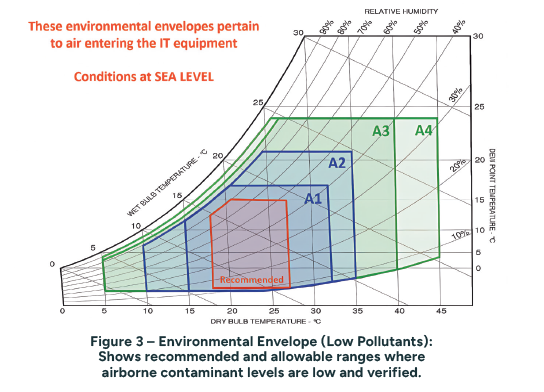
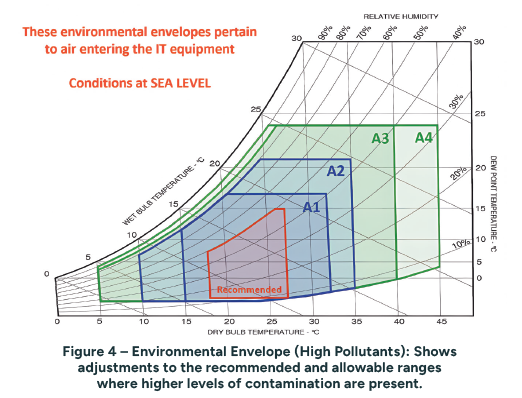
As can be seen from Figure 3 and Figure 4, 8% is the recommended lowest relative humidity (RH) for both clean and contaminated environments.
Risks and humidity
A study conducted by the ASHRAE-supported EMC Laboratory (2011–2014) examined the risk of electrostatic discharge (ESD) damage in data centres, particularly under low humidity conditions.
The results showed that reducing humidity does increase ESD risk, but not to a critical level. Even in data centres with higher baseline damage rates, lowering relative humidity from 25% to as low as 8% did not result in an appreciable increase in the incident rate of ESD damage.
Importantly, earlier concerns that low humidity would significantly increase ESD-related failures were not supported by the findings. When standard ESD control measures are applied, the risk of damage remains very low even at humidity levels below 8%.
Based on this evidence, ASHRAE expanded its environmental guidelines, allowing data centres to operate at lower humidity levels. This change enables energy and water savings, as humidification is no longer required in very dry conditions.
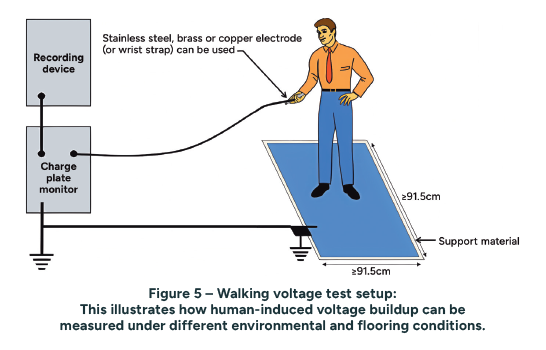
While the purpose of this article is not to go through the detailed procedure of the ESD research, this showed that lower humidity not only increased the charge voltages but also led to longer charge retention and more damaging discharges.
To explore this further, the following experiments were performed under various environmental, footwear, and flooring conditions (Pommerenke et al.2014):
- Human Charging test: The human body voltage of a person walking on the floor was measured as a function of floor type, footwear, grounding, and environmental conditions.
- Cable charging by spooling and dragging: Different cables were dragged across different surfaces, and the induced voltage was measured.
- Human metal discharge: A charged person held a metallic ground and discharged himself. Currents and electric fields were measured.
- Cable discharge: To emulate charges on a jacket, cables were wrapped with aluminum foil, the foil was charged to a given voltage, and the voltages induced on the wires were measured.
Only data from the measurement of voltages generated by the people working within the critical environment are reported in the Guidelines, as these test results were considered most directly related to the humidity requirements for the environmental classes. Results from other experiments can be obtained from the research project final report published by Pommerenke et al (2014).
Figure 3 and Figure 4 also show that the recommended upper limit for RH varies significantly between environments that have low levels of pollutants and those with high levels of pollutants, as verified by coupon measurements.
Coupon testing
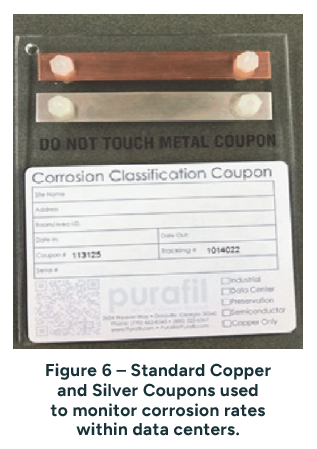
The ASHRAE TC9.9 Thermal Guidelines 5th Edition, recommends that coupon testing, using silver and copper coupons, be carried out at least twice a year (once in the winter and once in the summer) to establish the level of corrosion.
Recommended thermal envelope changes depending on the level of gaseous pollutants in the data centre.
For low levels of pollutants, the recommended upper range of humidity can be increased to 70%, whereas for environments where higher levels of pollutants are present, or for which no monitoring is taking place, the upper range of humidity should be reduced to 50%. High RH levels, when combined with increased levels of pollutants, have been shown to affect failure rates of electronic components.
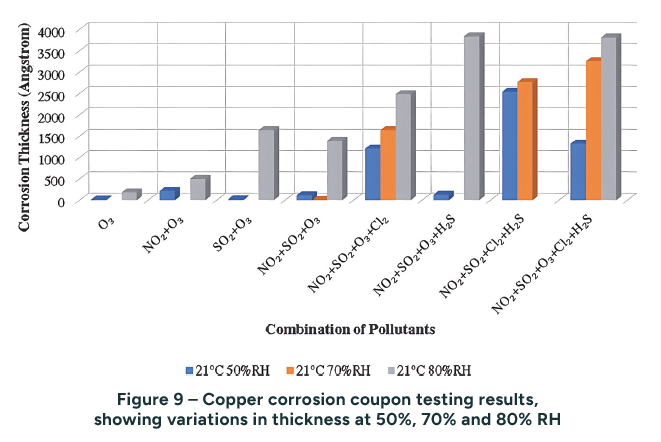
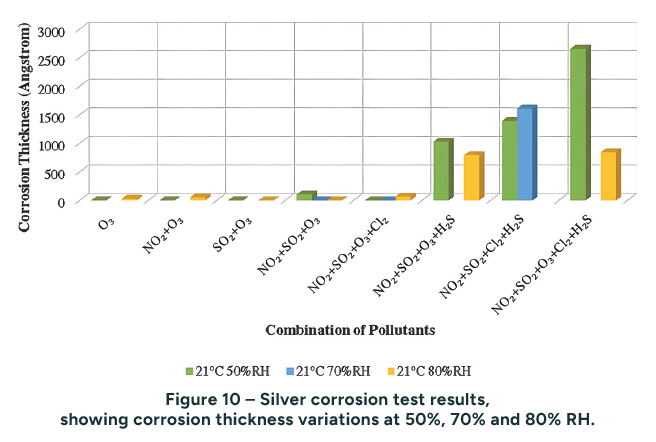
Examples of failure modes exacerbated by high RH include conductive anodic failures, hygroscopic dust failures, tape media errors and excessive wear, and corrosion. The new research reported in detail in the Thermal Guidelines sets the recommended upper RH limit at 70% for data centres that continuously monitor the corrosion rate of copper and silver and are shown to have levels below 300 Angstroms per month (Å/month) and 200 Å/month, respectively.
Investigating IEQ and reliability
In terms of research done into the effect of RH and Gaseous Pollutants on IT equipment reliability, ASHRAE funded research performed at Syracuse University from 2015 to 2018. The final report (Zhang et al.2019) was submitted to ASHRAE in December 2018 and a technical article summarising the research was published in 2020 (Zhang et al. 2020).
The objective of the research was to experimentally investigate how increasing the relative humidity (RH) and temperature beyond the ASHRAE recommended thermal envelope would affect the corrosion rate and the corrosion mechanisms of the primary metals used in the build of electronics: copper and silver.
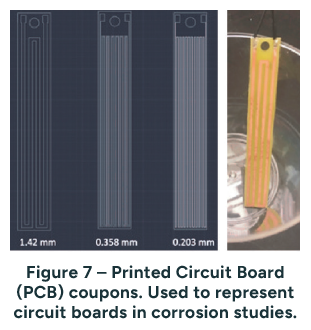
The following figures illustrate typical coupon arrangements and the test equipment used in the tests.
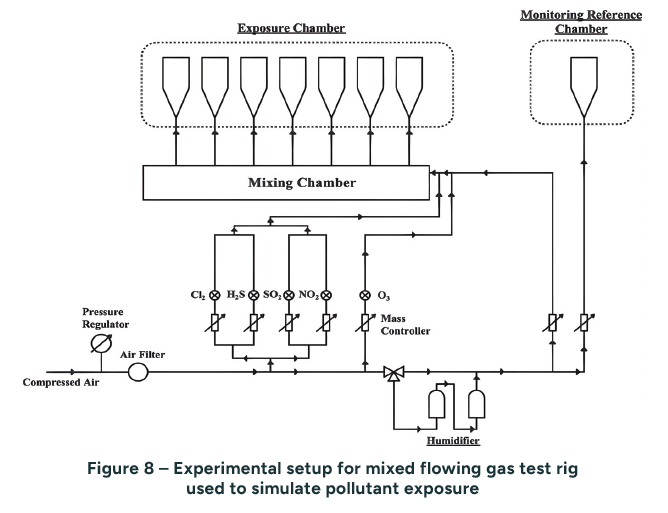
A comprehensive literature review has shown that NO2, SO2, O3, Cl2 and H2S are of most concern for corrosion in the data centre environment (Zhang et al.2018). NO2, O3, and SO2 are the most prevalent, and their outdoor concentration levels vary by location. Cl2 and H2S pollutants are generally caused by local events such as emissions from sewage treatment plants, decay of vegetation in wetlands, and off-gassing from soils. Usually, the worst-case scenario concentrations occur when outdoor air is used for Direct Air Cooling (Direct Air Optimization).
All tests were performed by first exposing the test specimens (standard copper and silver coupons or printed circuit boards) to pollutants within the controlled environment of an exposure chamber of a testing system (refer to Figure 8) specifically developed for the study. The test specimens were then analysed by coulometric reduction to determine the total corrosion thickness and quantities of major corrosion products.
The tests were done maintaining different test RH levels at a constant test temperature (21°C). Figure 9 and Figure 10 clearly demonstrate that when Cl2 and H2S are present, there is a significant change in the corrosion thickness, and it was this finding that led to ASHRAE specifying the two recommended operating envelopes for high- and low-level pollutants.
In summary, the work done by Zhang et al in collaboration with ASHRAE demonstrates an important aspect to the thermal operating range of data centres that is sometimes overlooked. The impact of airborne pollutants, when combined with elevated levels of humidity within the critical environment, can have a noticeable impact upon corrosion, and hence server failure rates, which data centre operators should not ignore.
Acknowledgements
The author used insight from the ASHRAE Thermal Guidelines (Fifth Edition), Chapter 2.
The author also acknowledges:
Mentorship and guidance by: Malcolm Howe BEng (Hons) CEng MCIBSE MIEI ASHRAE – Partner, Critical Systems, Cundall London Office
Cundall critical systems team:
- Benny Cheah – Director of Building Services, Melbourne
- Stewart Mann – Director of Building Services, Melbourne
- Liam Kearns – Principal Mechanical Engineer (Critical Systems), Sydney
- Mohammed Islam – Mechanical Engineer, Melbourne
About the author
Priyatharsan Sachchithanantham is a Chartered Engineer and AIRAH Member with over 13 years of experience in the construction industry, including nine years in Singapore. He has held roles across both contractor and consultancy environments, specialising in HVAC systems. He is currently working as a Senior Mechanical Engineer at Cundall, focusing on data centre design and delivery.
Most recently, he acted as the Deputy Mechanical Lead on a hyperscale data centre project in Melbourne that featured liquid cooling technology. Priyatharsan’s broad project portfolio spans data centres, residential developments, aged care facilities, hospitality, community recreation centres, and educational institutions.
References
- Thermal Guidelines for Data processing Environments – Fifth Edition Revised and Expanded – ASHRAE Datacom Series Book
- The ASHRAE Thermal Guidelines for Data centres Past, Present, and Future by Dustin W. Demetriou Ph.D, Member ASHRAE
- Actual Data Centre Projects
This article appears in Ecolibrium’s Winter 2026 edition
View the archive of previous editions
From our advertisers
Recent articles



Latest edition
See everything from the latest edition of Ecolibrium, AIRAH’s official journal.