Ultra-low dew point design in action


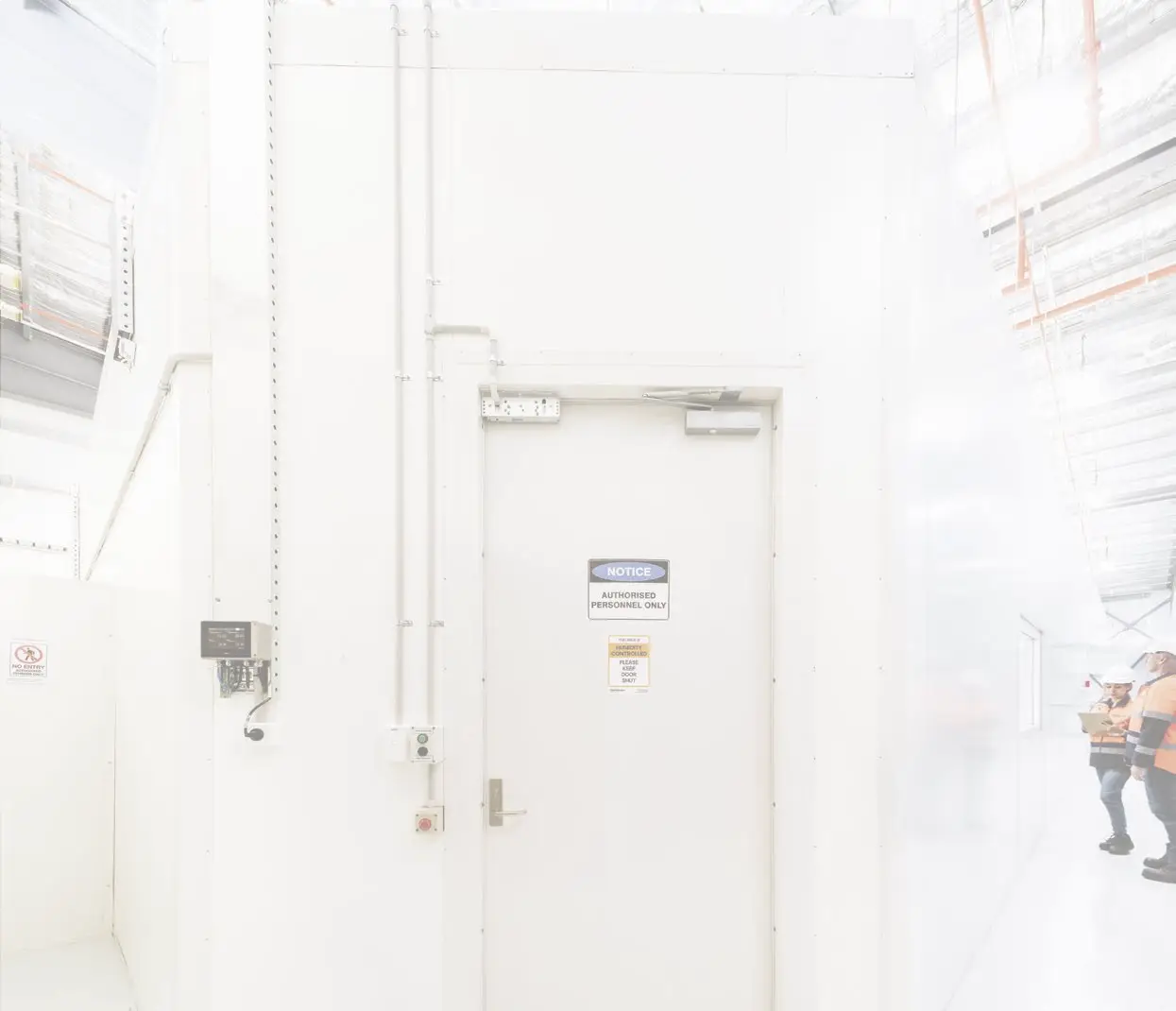
In this case study, Humiscope Director John Morgan and Mechanical Engineer Ladan Bagherzadeh look at the challenges of designing and delivering an ultra-low dew point environment for lithium‑sulphur battery manufacturing.
Lithium metal reacts aggressively with moisture, and even trace levels of water vapour can compromise product integrity and create significant safety risks. As lithium-sulphur (Li-S) battery production transitions from laboratory research to automated manufacturing, environmental control becomes a fundamental process requirement rather than a comfort parameter.
Scaling Li-S technology has historically been constrained not only by electrochemistry, but also by the ability to manufacture under tightly controlled environmental conditions.
The project described here represents a recent installation within an Li-S battery manufacturing facility in Victoria, Australia.
In 2022, Australian engineering company Humiscope was engaged to design and construct an ultra-low humidity dry room within a 220m², 2MWh automated battery production facility. The brief required a controlled environment capable of maintaining a dew point of -45°C or lower at 22°C.
The completed facility now operates at 22°C and approximately 0.4% relative humidity (RH), equating to roughly -60°C dew point, exceeding the original performance specification while maintaining a controlled pressure cascade between the primary room and antechamber.

At extremely low dew points, such as at this facility, occupancy is one of the main drivers of humidity.
Psychrometric design basis
The design objective was to maintain -45°C dew point or lower at 22°C without reliance on glove boxes or inert enclosures. Outdoor summer and winter design conditions were selected using AIRAH climate data for Geelong.
At dew points between -45°C and -60°C, moisture loads are dominated by infiltration and occupancy rather than sensible cooling. In this application, the principal latent loads arose from occupants and outdoor air introduced through ventilation and infiltration, while process equipment contributions were comparatively minor.
To maintain the target condition, supply air was delivered at a dew point approximately 10°C lower than the room setpoint, providing sufficient drying margin to offset internal and infiltration moisture loads.
In ultra-low dew point environments, pressurisation alone does not eliminate moisture ingress. While a pressure cascade ensures outward airflow from the dry room to adjacent spaces, moisture migration is driven primarily by vapour pressure differences rather than total air pressure.
At dew points between -30°C and -60°C,
the vapour pressure gradient between the dry room and surrounding spaces can significantly exceed the room pressurisation differential. Adjacent areas such as ceiling plenums or service zones can therefore introduce a continuous latent load through vapour diffusion even when the room is positively pressurised.
For this reason, dew point conditions in neighbouring spaces must be considered as part of the overall moisture balance when sizing desiccant equipment, determining regeneration capacity and establishing operational safety margins during peak ambient conditions.
Desiccant system selection and integration
Dew points in the range of -45°C to -60°C exceed the practical limits of refrigeration‑based systems alone. At these humidity ratios, desiccant drying is required to achieve deep moisture removal without excessive cooling and reheat penalties.
A silica gel rotary desiccant wheel was selected as the primary drying mechanism due to its stable adsorption characteristics in ultra‑low humidity applications. The wheel operates with electric regeneration, providing consistent desorption energy independent of external heat sources.
The desiccant system was supplied by Humiscope’s long-standing manufacturing partner, TFT Dry Air Solutions, a specialist provider of deep drying technology for industrial manufacturing applications. Ensuring the selected equipment configuration aligned with the psychrometric requirements and operational objectives of the facility required close collaboration.
The system incorporates both pre- and post‑cooling coils. Pre-cooling reduces the latent load entering the wheel, while post‑cooling stabilises supply air temperature. Integration with a glycol chiller enables independent control of sensible and latent loads, allowing -60°C dew point operation while maintaining 22°C room temperature.
Heat recovery between process and regeneration air streams was assessed but was not required for this project.
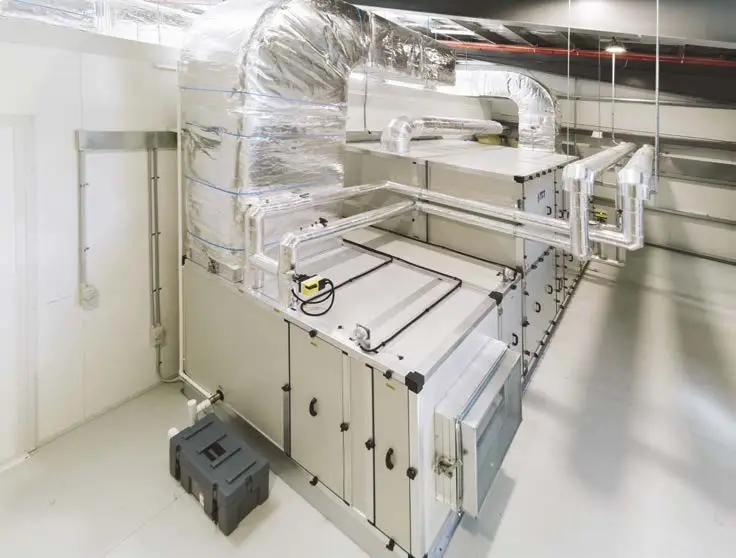
The air distribution solution incorporates sealed ductwork and staged filtration.
The system selection and integration approach was informed by ongoing engagement with international battery manufacturing forums. Over a three-year period leading up to and during the project, Humiscope Director John Morgan attended several European conferences focused on battery factory dry room design, construction and operations, including the Annual Excellence in Battery Factory Dry Room Design, Construction, Engineering and Operations Forum. Exposure to emerging international best practice in deep drying applications informed the design philosophy adopted for the Victorian facility.
Air distribution and filtration strategy
Conditioned dry air is distributed through a sealed duct network incorporating staged filtration.
The system includes G4 pre-filtration, F7 secondary filtration and HEPA filtration to ensure particulate control alongside humidity management.
Supply air dew point is maintained between -65°C and -70°C to support stable room operation at -60°C under load. Uniform air distribution was prioritised to minimise localised moisture accumulation and prevent stagnant zones that could compromise process reliability. The airflow regime ensures consistent environmental conditions across the production floor while supporting dilution of incidental moisture introduction.
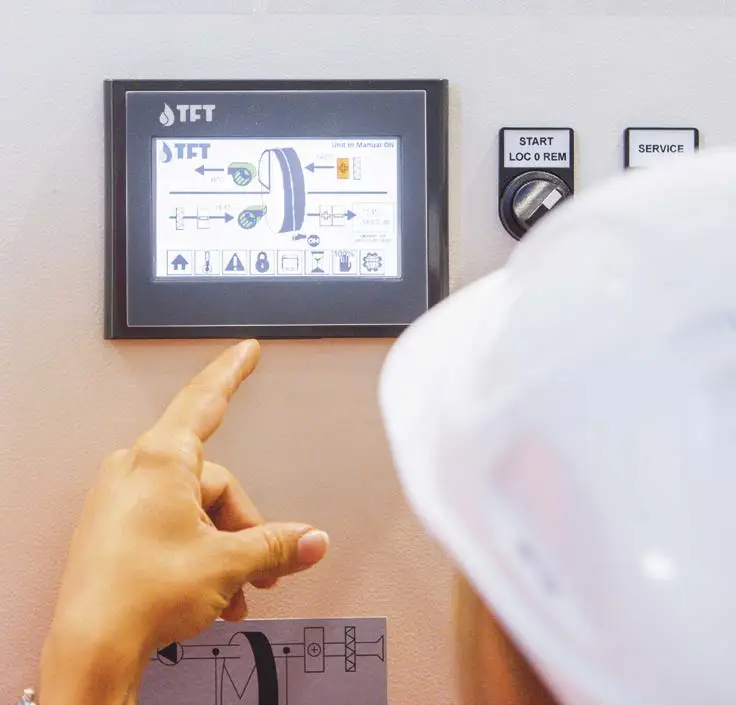
Unlike other facilities, dew point is the primary control variable.
Envelope design and leakage control
At -60°C dew point, envelope performance becomes a primary determinant of stability. Even minor uncontrolled leakage can impose significant latent loads.
The dry room was constructed using fire‑rated wall and ceiling panels and operates under positive pressure to minimise ambient moisture ingress. Controlled pressure settings between the main room and antechamber limits infiltration pathways.
Service penetrations were minimised and sealed using gland plates within the electrical design. A formal room pressure test verified airtightness prior to full commissioning. Panel joints and service interfaces were carefully sealed during construction, enabling commissioning to proceed without significant leakage rectification.
In ultra-low humidity applications, vapour barrier integrity and pressurisation are as critical as dehumidifier capacity in achieving long-term stability.
Control strategy and monitoring
Ultra-low dew point environments require precise and continuous monitoring. Dew point, rather than relative humidity, was selected as the primary control variable.
The system employs a dew point meter for continuous measurement and control. Dew point data is integrated into the building management system and supplemented by remote monitoring capability, allowing performance oversight and adjustment as required.
Direct dew point control avoids inaccuracies associated with relative humidity measurement at extremely low moisture levels.
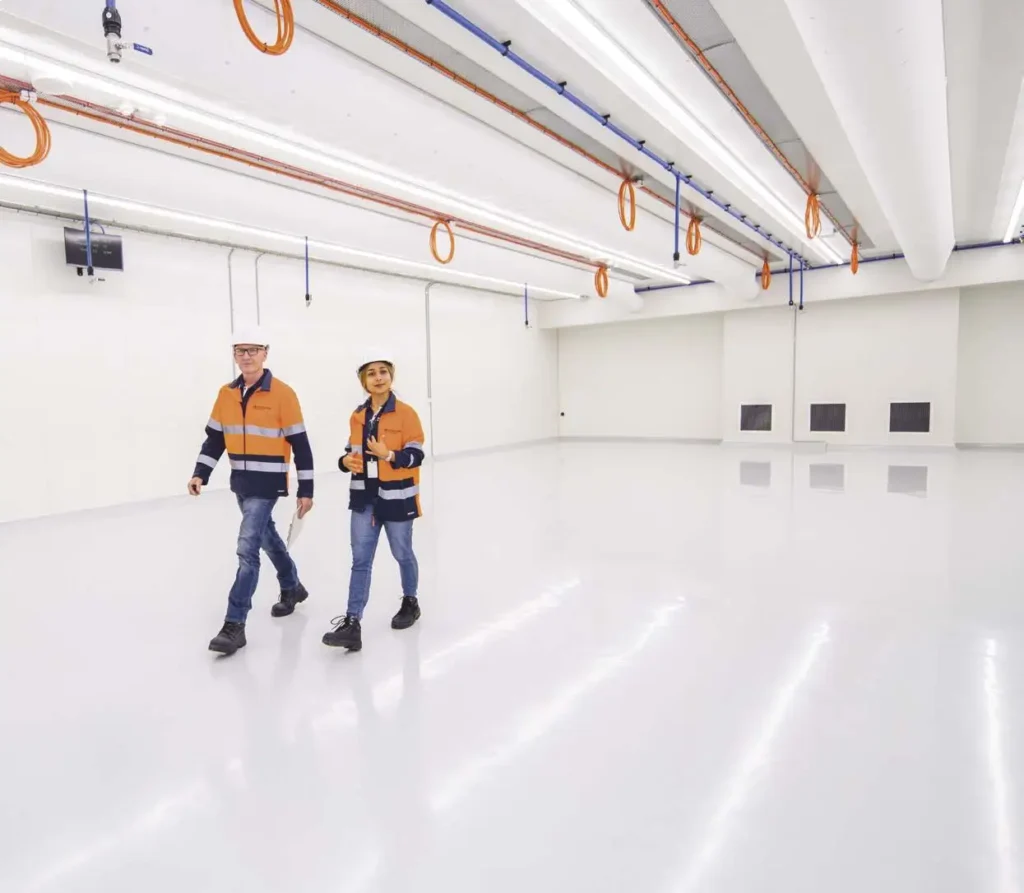
In the three years leading up to the project, Humiscope director John Morgan learnt as much as possible about the requirements for battery dry rooms
Commissioning and performance validation
Commissioning verified the room’s ability to achieve and sustain the required environmental conditions.
Performance stability was tested for more than 72 continuous hours, demonstrating consistent operation within the -60°C range. Under full occupancy load, conditions were maintained between -55°C and -60°C dew point, confirming that the design appropriately accounted for internal moisture contributions.
Subsequent site verification measurements recorded dew point levels as low as -70°C, providing additional performance headroom beyond the original -45°C specification.
This performance reflects effective system tuning during commissioning and the high level of envelope airtightness achieved during construction.
Implications for advanced manufacturing
Ultra-low humidity environments are increasingly critical as Australia expands its advanced manufacturing capability, particularly in battery technology.
The integration of desiccant deep drying, pressure-controlled envelope design and validated leakage control strategies provides a scalable framework for lithium and other moisture-sensitive manufacturing processes. As production transitions from laboratory development to automated manufacturing, environmental engineering will remain a key enabler of process stability, safety and yield.
Doing the dew
Founded in 2015, Humiscope is an Australian-owned engineering company specialising in precision indoor humidity control and desiccant and refrigerant dehumidification systems. The company designs, integrates and commissions ultra‑low dew point and controlled‑humidity environments for advanced manufacturing, food processing and pharmaceutical applications across Australia.

John Morgan, and Ladan Bagherzadeh (left to right)
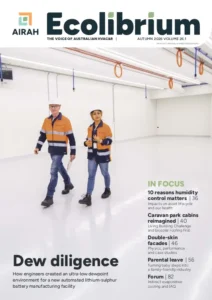
This article appears in Ecolibrium’s Autumn 2026 edition
View the archive of previous editions
From our advertisers
Recent articles


Latest edition
See everything from the latest edition of Ecolibrium, AIRAH’s official journal.